
Module 1 · 1.3
Registry, registrar and reseller
Module 1: How the domain system works · Reading time: 9 minutes
Learning objective: After this lesson you can explain the chain of registry, registrar, reseller and registrant, and you know who to go to for which problem.
Key concepts: registry, registrar, reseller, registrant, contract with the registrar, terms and conditions of the registry, who to contact for which problem
The chain from top to bottom
In lesson 1.1 you saw the three parties behind a domain name. The DNS course (lesson 1.3) explains them briefly from a technical point of view. Here you look at them as a registrant: who do you have an agreement with, and who can do what for you?
The chain looks like this:
- The registry manages one extension and the register of all names under it (lesson 1.2).
- The registrar has a contract with the registry and is allowed to add, change and renew names in that register. At DENIC, a registrar is called a member (DENIC-Mitglied). For gTLDs such as .com, a registrar also needs accreditation from ICANN.
- Sometimes there is a reseller in between: a company that resells names through a registrar but is not a registrar itself.
- At the bottom is you: the registrant.
You almost never register a name directly with the registry. There is one exception you may come across: at DENIC, a registrant can also arrange a .de name without an intermediary through DENICdirect. For .nl, .eu and .be it always goes through a registrar.
Two contracts, one name
As a registrant, you deal with two kinds of agreement.
- A contract with your registrar (or with your reseller). This sets out the term, payment, notice period and the services that come with it.
- The terms and conditions of the registry. These apply to you too, even though you don't sign them with the registry itself. With .nl you are even a direct contracting party of SIDN: the registrant is the party the registry makes the registration agreement with.
That has consequences. With .nl you can switch registrar at any time. But your contract with the old registrar does not end automatically: what you still owe there depends on your agreements with that registrar. So the registry handles the name, and your registrar handles the service around it.
The registry also requires the name to be registered in the name of the real registrant. For .nl and .eu, the registrant may not be the registrar, the reseller or a service that only "lends" its name for privacy. If your domain is registered in your web developer's name, then for the registry the web developer is the registrant. Only the registrant can arrange a transfer, recover a name from quarantine or change the registrant.
The reseller: handy, but an extra link
Many web developers, hosting companies and marketing agencies sell domain names without being a registrar themselves. They are then a reseller. That is perfectly normal and nothing wrong. In the .nl Whois you even see the reseller listed separately, next to the registrar.
A reseller is an extra link, though. Everything you want goes through them to the registrar and then to the registry. If the reseller stops trading, doesn't respond, or you fall out with them, you need to know which registrar is behind them. You can find that in the Whois or RDAP of your domain (module 4).
A situation like this usually ends well if you are registered as the registrant. You simply request the transfer code and move to a registrar of your choice. For .nl, your registrar must give you the code within five days; if that doesn't happen, your new registrar can bring in SIDN. If the name isn't registered in your name, that's when the real trouble starts.
Who do you contact for which problem?
This is the question people get wrong most often. They call the registry about a slow website, or ask their hosting company to sell a name that is registered to someone else. A few rules of thumb:
| Situation | Who to contact |
|---|---|
| You want the transfer code for your domain | Your registrar (or your reseller) |
| Your registrar doesn't give you the .nl transfer code within five days | Your new registrar, who can bring in SIDN |
| Your mailbox is full or your website shows an error | Your hosting company or email provider |
| You want your business partner to be the registrant from now on | You decide as the registrant; your registrar carries it out |
| Your .nl name has been cancelled and you don't know why | Your registrar: SIDN doesn't know the reason |
| You receive an invoice from an unknown "domain registry" | Don't pay anyone; ask your own registrar |
You can see a pattern. Your registrar is your point of contact for everything in the register: registration, renewal, nameservers, contact details, transfer code. Your hosting company is responsible for the computer your website and email run on. You rarely contact the registry; your registrar does that. And some things nobody can do for you: what happens to the name is decided by you as the registrant.
Note: your registrar and your hosting company are often the same company, but not always. And the party that manages your DNS may be yet another one (the DNS course covers this in more detail). So first check who does what before you call anyone.
Pitfalls in the chain
- The registry that isn't a registry. SIDN does not sell .nl names to registrants itself. If someone calls or emails you posing as "the registration authority" and wants to sell you something, it isn't SIDN.
- The forgotten reseller. Your web developer once set up your domain and has since stopped trading. The name expires, and nobody gets the reminder. So always know which registrar is behind it.
- The wrong registrant. If your domain is registered in the name of the web developer, an employee or the registrar, you don't really control the name (lesson 3.2).
In practice: how it works at WebOké
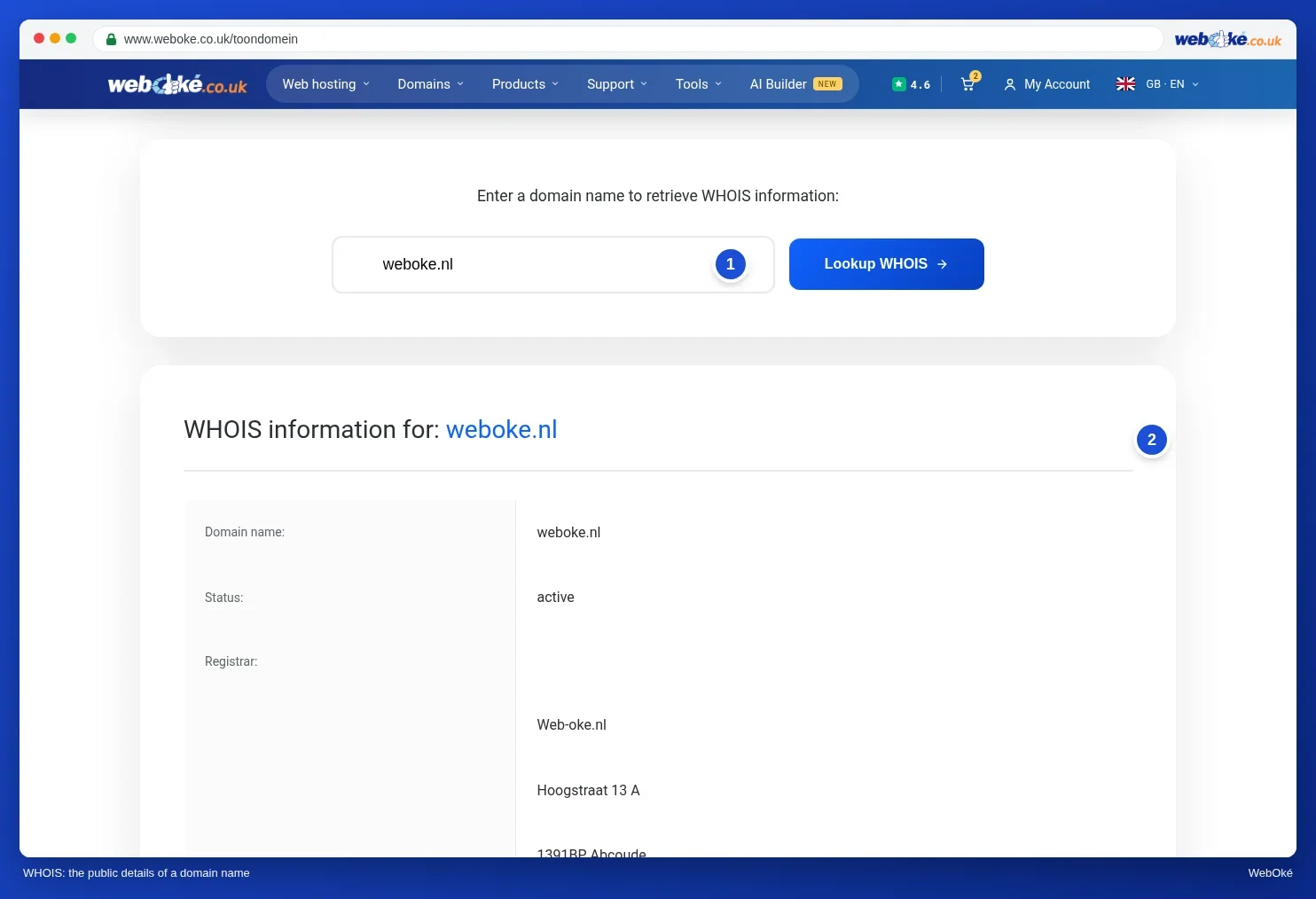
To find out which registrar is behind a domain, use a WHOIS tool. At WebOké this is the WHOIS lookup at https://www.weboke.nl/en/toondomein. You enter a domain name and see, among other things, the status and the registrar. For your own domains at WebOké, everything is in My WebOké under My Domains: that's also where you request the transfer code and change the contacts. Other registrars work in a similar way, only the buttons have different names.
Summary
- The chain is registry, registrar, possibly a reseller, and the registrant.
- You have a contract with your registrar, and the registry's terms and conditions apply to you too.
- A reseller is not a registrar itself; always know which registrar is behind it.
- Your registrar is the point of contact for everything in the register, your hosting company for website and email.
- Decisions about the name itself are made by you as the registrant.
Quiz
Exercise
Exercise A1.3: Who should you go to? (case study). Bakkerij Example runs into four issues. For each situation, choose who the bakery should go to:
- The bakery's .nl name needs to be renewed.
- The bakery's website has been loading very slowly for days.
- Another baker offers to take over the domain name. Someone has to decide whether the name will be sold.
- The bakery is moving its DNS to another provider and needs the domain's nameservers changed.
For each situation you choose from the same four options:
- your registrar
- the registry
- your hosting company
- yourself as the registrant
The program compares your answers with a fixed key. All four correct means green.