
Holder change and handover
Module 6: Transferring and changing ownership · Reading time: 10 minutes
Learning objective: After this lesson you can hand a domain over to another holder, for example after a sale, a takeover or a company split, and you know when that is a holder change, a transfer or both.
Key concepts: holder change, updating details, handover and transfer, consent, sale and escrow, business takeover, death and bankruptcy, transfer lock after a holder change
Three things that look alike
When a domain "goes to someone else", that can mean three different things. If you mix them up, you arrange the wrong thing or accidentally put the domain in the wrong name.
| What | What changes | Example |
|---|---|---|
| Updating details | Nothing about who the holder is; only the address, phone number or email | The bakery moves to new premises |
| Holder change | Another person or organisation becomes the holder | The bakery sells a shop together with its name |
| Transfer | The name moves to another registrar; the holder stays the same | The bakery moves its names to another registrar |
A holder change has the biggest legal impact. For .nl, the contract with the old holder ends and a new contract starts with the new holder. From that moment on, the domain belongs to the other party.
Watch the difference between another person and other details. If you turn your sole proprietorship (eenmanszaak) into a private limited company (bv), the bv is a new legal entity. Even if you are still the boss, the domain has to go to the bv through a holder change. The other way round: if the holder stays the same and only the business moves, you just update the details.
Many registrars always treat a different name or organisation in the holder details as a holder change, even for a small correction. So check what you enter before you save.
Consent from both sides
A holder change is started by the current holder or happens with their consent. Only a dispute resolution procedure or a court can decide on it without them (lesson 7.2). The new holder, in turn, accepts the terms of the registrar and the registry: they enter into a new contract. So nobody can "just change your holder" without your cooperation. If you receive a request like that which you did not expect, treat it as an attempted hijacking (lesson 7.1).
That is also why it is so awkward when a domain is in the name of a former employee or a web developer (lesson 3.2). Only the holder can hand the name over. If they will not cooperate, you have a problem you would have been better off preventing.
How a holder change works per extension
As of November 2026:
- .nl: you arrange it through your registrar. SIDN sends a confirmation to the administrative contact and the registrar.
- .de: DENIC calls it a Domainübertragung (in practice often Inhaberwechsel). It goes through the provider and can be combined with a change of provider. If there is a DISPUTE-eintrag on the name (lesson 7.2), it cannot go to someone else.
- .eu: you use the same authorisation code as for a transfer. The new holder must meet the .eu requirements themselves: a citizen or resident of an EU country, Iceland, Liechtenstein or Norway, or established there. So you cannot sell a .eu name to a company established outside those countries.
- .be: you request the transfer code from DNS Belgium and give it to your current registrar, asking them to put the name in the new holder's name.
- .com and other gTLD's: this is called a Change of Registrant. Afterwards the registrar sets a 60-day transfer lock, unless you chose to skip it before the change (if the registrar offers that).
Changing holder and registrar at the same time
If the name goes to a new holder who also wants it at another registrar, you do two things. The order matters.
For .nl, either order is fine: first change the holder and then transfer (the new holder then requests the code themselves), or first transfer and then change the holder. For .eu, the code goes to the new holder's registrar, which handles both steps.
For .com, the order matters more. If you change the holder first, the name is then locked for 60 days, unless you skipped that lock beforehand. If the buyer wants to move to their own registrar straight away, transfer first and change the holder afterwards. Or choose to skip the lock beforehand, if that is possible.
Selling or buying a domain
A sale is all about trust: who goes first? If the buyer pays up front, they risk never getting the name. If the seller hands it over first, they risk never getting the money.
An escrow solves this. A neutral party holds the money until the name is in the buyer's name. The buyer pays the escrow, the seller hands over the name, the buyer confirms, and only then does the seller get the money.
As a buyer, check beforehand:
- whether the seller really is the holder (for organisations the name is often shown in WHOIS, lesson 4.1);
- what status the name has (lesson 4.3) and whether there is a dispute;
- whether mail still arrives on the name that is really meant for the old holder.
After the handover, check the registrar and the status in RDAP or WHOIS, put your own contacts on it and arrange the renewal (module 5).
Takeover, split, death and bankruptcy
Takeover through shares. If someone buys the shares of the bv that is the holder, that bv remains the holder. Nothing changes in the registration. Do check whether the contact addresses still belong to people who work there.
Takeover of a part. If someone buys only a shop, a brand or a website, the domain goes to the buyer through a holder change. Record in the purchase agreement which names are included, including the variants and extensions you registered defensively (lesson 7.2).
Splitting a company. Decide per domain who gets it, and carry out a holder change per domain. Remember that the email addresses on that name go along with it.
Death or bankruptcy. The holder can then no longer arrange anything themselves. The heirs or the receiver contact the registrar, who asks for proof. What happens next depends on the registrar and the registry's rules. It helps enormously if the domain is in the name of the organisation and not in the name of one person (lesson 3.2).
In practice: how it works at WebOké
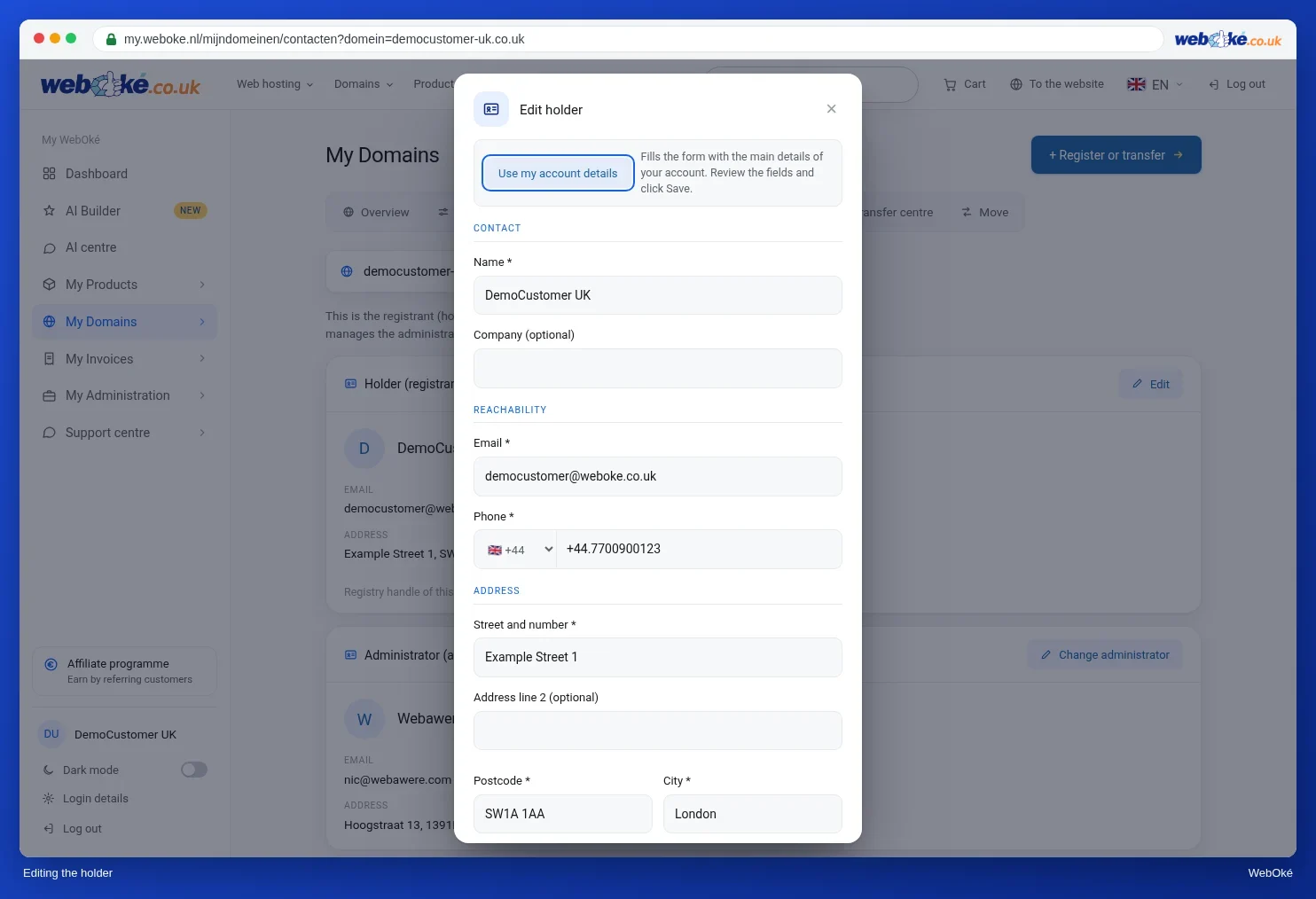
In My WebOké you manage the holder in the Contacts tab, with Holder (registrant), Change holder, Link another holder and New contact. If you change the name or the organisation, you see the message "Note: this is a holder change".
The Advanced card also has Transfer to another customer. This moves the domain into the account of another WebOké customer. The holder goes along unchanged: nothing changes at the registry. If that other customer also needs to become the holder, you do a holder change as well. Other registrars work in a similar way: another account is not the same as another holder.
Summary
- Updating details, a holder change and a transfer are three different actions.
- A holder change makes someone else the legal holder; a sole proprietorship that becomes a bv is a new holder.
- The route differs per extension: .eu and .be use the registry's code, .com sets a 60-day transfer lock afterwards.
- In a sale, an escrow protects buyer and seller; check the holder and status beforehand.
- Another account at your registrar is not the same as another holder.
Quiz
Exercise
Exercise A6.4: Holder change or transfer? (case study). Read the four situations and choose for each one what needs to happen.
- Bakkerij Example sells its second shop to another baker. The shop has its own .nl name. The buyer keeps the name at the same registrar.
- Bakkerij Example moves to new premises in Utrecht and gets a new phone number. Everything else stays the same.
- The owner turns his sole proprietorship into a bv. The business's .eu name has to be put in the name of the bv, and he wants to move it straight away to the registrar where his other domains are.
- Bakkerij Example moves its .com name to another registrar. The bakery remains the holder.
For each situation, choose from: Holder change, Transfer, Both, Only update details. The program compares your answers with a fixed key. If a situation is wrong, you get a hint and can try again.