
WebOké Backups: viewing, restoring, or downloading a backup
WebOké Backups is our own backup system. Every night, we make a complete backup of your hosting package: your files, databases, mailboxes and settings. We store those backups encrypted on separate storage servers in a separate datacenter, under our own management, so separate from the server your website runs on. You can restore something yourself, for free and without our intervention, from the backups of the past 30 days.
In this article:
- What's included in the backup?
- Opening WebOké Backups
- The wizard in six steps
- The four ways of restoring
- Practical examples: individual emails, a WordPress site
- Downloading and uploading
- Previous restores
- Frequently asked questions
What's included in the backup?
For each hosting package, we store per night:
- all files in your home folder, including your websites;
- your databases, including the database users with their passwords and permissions;
- your mailboxes and mail settings (aliases, filters, autoresponders);
- the DirectAdmin configuration: domains, subdomains and redirects;
- DNS zones, SSL certificates, cron jobs, FTP accounts and your PHP version.
For a mail package, we store the mailboxes and the DirectAdmin settings.
Opening WebOké Backups
- Log in at my.weboke.nl.
- In the menu on the left, go to My Products and choose WebOké Backups in the submenu. WebOké Backups is also listed in the tab bar at the top of every product page.
- You can also go directly to my.weboke.nl/backups.
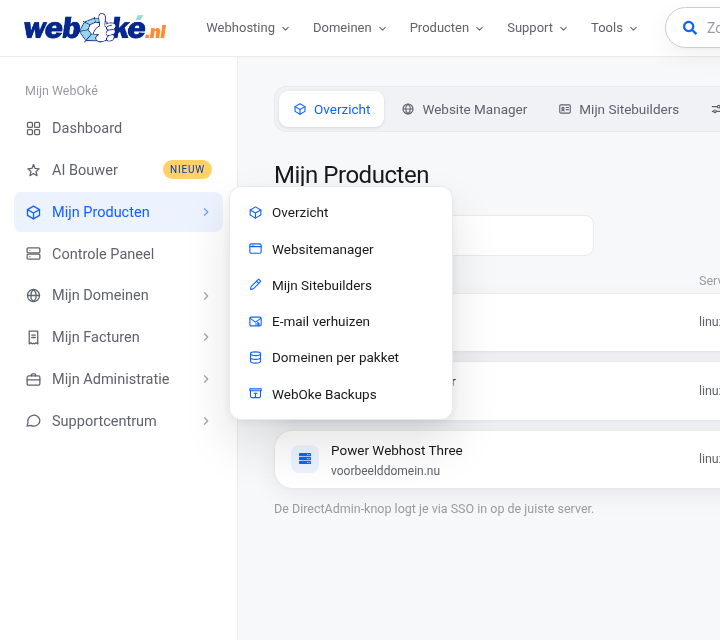
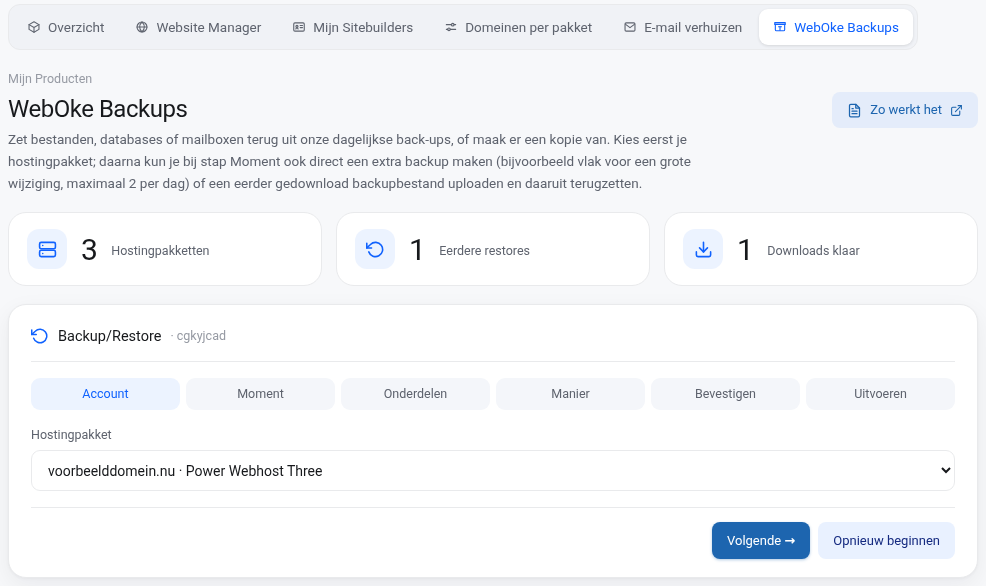
At the top of the page, you'll see three tiles: the number of hosting packages, the number of previous restores and the number of downloads ready for you. The How it works button opens this article. Below that is the wizard you use to restore, followed by your previous restores, your downloads and uploads, and a brief explanation of the ways of restoring.
The wizard in six steps
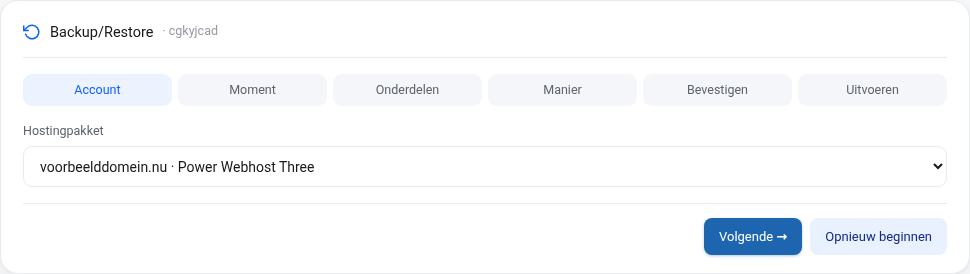
The wizard guides you through six steps. Use Next and Previous to move through the steps, and Start over to begin again.
Step 1: Account
Choose the hosting package you want to restore something from. If you have many packages, there's a search field above the list. If you have a reseller package, you then choose which account it concerns: your own account or one of the accounts you've created.
Step 2: Moment
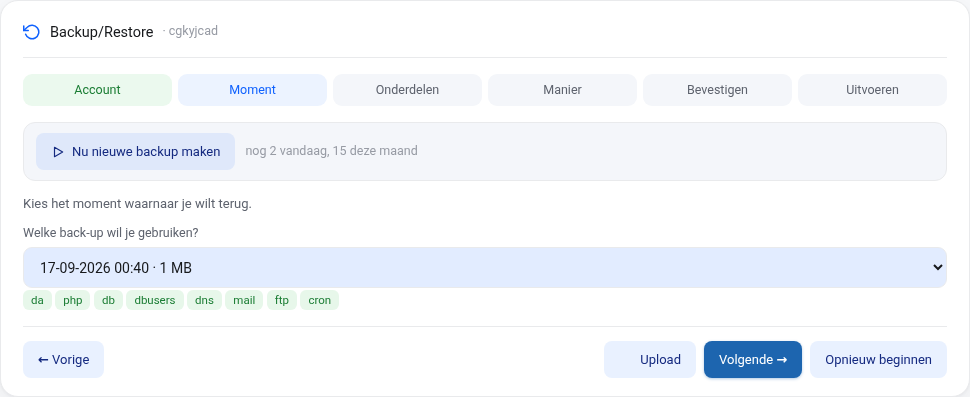
You'll see all available backup moments with date, time and size. By default the newest one is selected. Choose the moment you want to go back to. Below the dropdown you'll see which components are included in that moment.
In this step you can also do two other things:
- Create new backup now: immediately create an extra backup of your account, for example right before a major change to your website. This can be done a maximum of 2 times per day and 15 times per month. Once the backup is ready, the new moment appears in the list. Per day, we eventually keep the last backup of that day, so an extra backup is mainly a restore point for that day itself.
- Delete extra backup: an extra backup you made yourself can also be deleted. Select that moment in the dropdown, enter your password and click Delete this backup. After that, you can no longer restore anything from it. A deleted extra backup still counts towards your limit for today and this month. The nightly backups cannot be deleted: they remain in place so there's always a restore point, and disappear automatically after 30 days.
- Upload (the button at the bottom): restore from a backup file (.tar.gz) that you previously downloaded via this screen. The file is automatically deleted again after 48 hours.
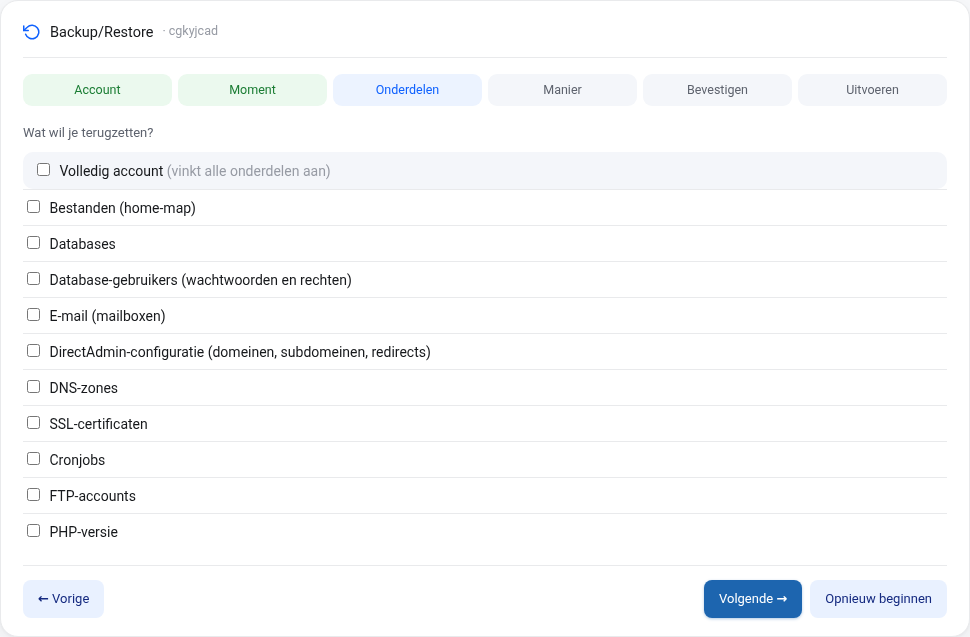
Step 3: Components
Check what you want to restore. You can select one or more components:
- Files (home directory): the entire home directory, or only certain folders and files. If you choose the latter, you browse through the backup as in File Manager, or search by name (minimum 3 characters) and check what you need.
- Databases and Database users (passwords and permissions).
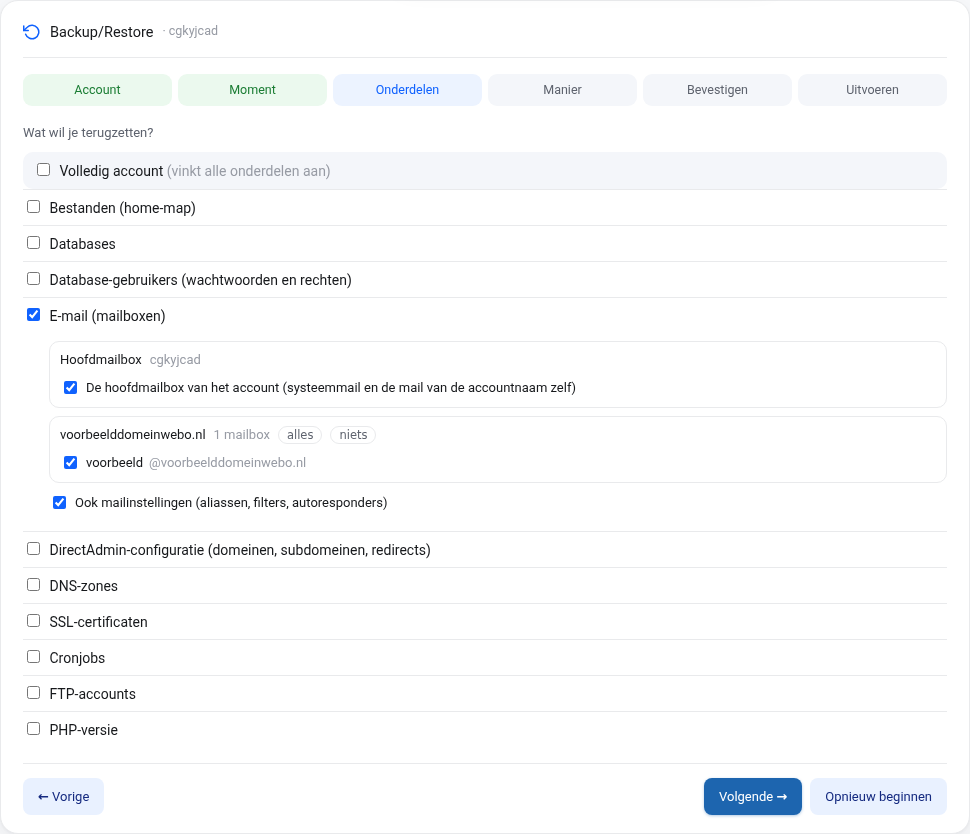
- Email (mailboxes): the account's main mailbox and per domain all or individual mailboxes, optionally also the mail settings.
- DirectAdmin configuration, DNS zones, SSL certificates, Cron jobs, FTP accounts and PHP version.
With Full account you check everything at once. For a mail package you can only choose mailboxes and the DirectAdmin settings.
Step 4: Method
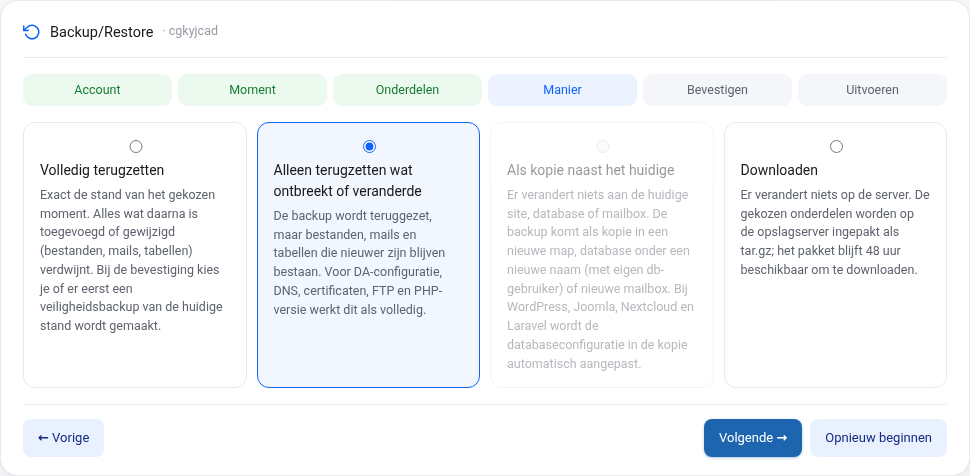
Choose how you want to restore. The four methods are explained further on in this article.
Step 5: Confirm
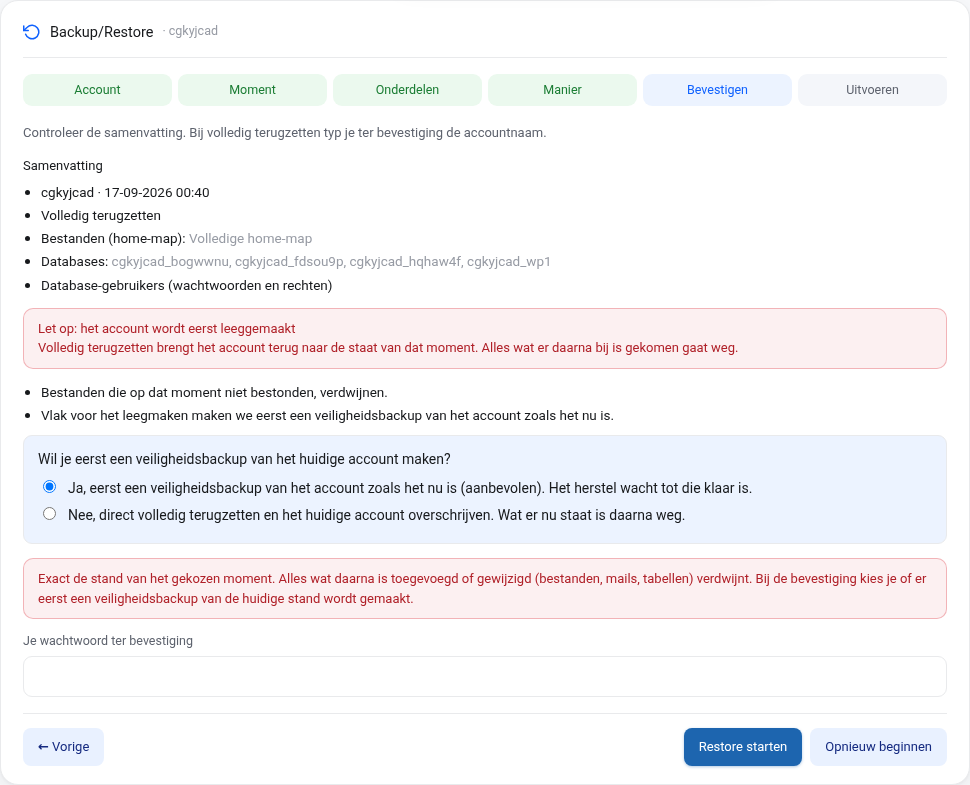
You'll see a summary of your choices. If you choose full restore, you'll first see what will be removed when the account is emptied and what will be recreated. You choose whether we make a safety backup of the current state beforehand (recommended, on by default) and enter your password to confirm. Then click Start restore. For a full restore, we'll ask you once more afterwards to confirm you're sure.
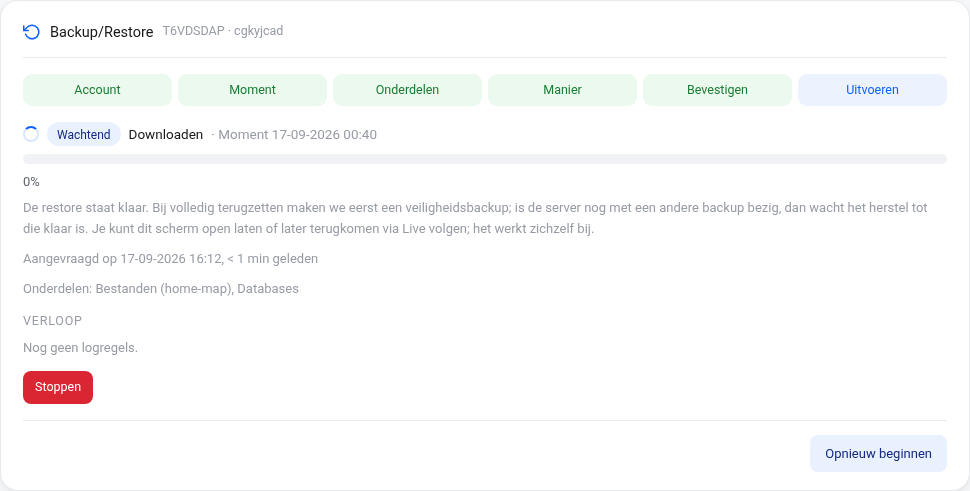
Step 6: Execute
The restore goes into the queue and usually starts within a minute. If a backup is running on the server at that moment, the restore waits until it's finished; for a full restore, we first wait for the safety backup. You'll see step by step what's happening, the screen updates itself. You can safely close the page: at the top of the WebOké Backups page, the notice A restore is running remains visible with the Follow live button, and once the restore is finished, or should it fail, you'll receive an email. You can abort a running restore with Stop, and start a failed restore again with Try again. As long as a restore is running, you can't start a new restore for that account.
The four ways of restoring
- Full restore: exactly the state of the chosen moment. The account is first emptied and then restored; anything added or changed after the chosen moment (files, mail, tables) disappears. At confirmation you choose whether we first make a safety backup of the current state, so you can always go back. That option is enabled by default.
- Only restore what's missing or changed: the backup is restored, but files, mail and tables that are newer than the backup remain in place. Handy if you accidentally deleted something. For the DirectAdmin configuration, DNS, certificates, FTP and the PHP version, this works the same as a full restore.
- As a copy alongside the current one: nothing changes to your current website, database or mailbox. The backup is added as a copy in a new folder, as a database under a new name (with its own database user), or as a new mailbox. This way you can calmly check what was in the backup. For WordPress, Joomla, Nextcloud and Laravel, we automatically adjust the configuration file of the copy to match the new database. If you want to view the copy under a different URL, you can fill that in. The new database details are shown only once, so save them right away.
- Download: nothing changes on the server. The chosen components are packaged as a tar.gz file that you can download for 48 hours. You can receive an email as soon as the package is ready.
Practical examples
Recovering deleted emails or a deleted mailbox
- Under Account, choose the package, and under Moment, choose a backup from before the deletion.
- Under Components, check only Email (mailboxes), and underneath that, only the mailbox you want back.
- Under Method, choose Only restore what's missing or changed.
The deleted emails will return to the mailbox. Emails you received after that moment remain untouched. This also works for a mailbox you deleted in DirectAdmin: it will come back with the mail that was in it. If you want to take a calm look first, choose As a copy alongside the current one. The backup is then placed in a new mailbox. This can be done for one mailbox at a time.
Restoring a WordPress site after a failed update or a hack
A WordPress site consists of two parts: the files and the database. Always restore these together, from the same moment.
- Choose the package and a moment from before the problem.
- Under Components, check Files (home folder) and choose only the site's folder, usually
domains/yourdomain.nl/public_html. Also check Databases with the site's database. You can find out which one this is inwp-config.phpunderDB_NAME. - Not sure? Then first choose As a copy alongside the current one. We automatically adjust the
wp-config.phpof the copy to match the new database, so you can view the old version without changing anything. - If you really want to revert the site to that moment, choose Full restore and leave the safety backup enabled. At Confirm, you'll see exactly what will disappear.
Alternative for WordPress: an Installatron backup
If you installed WordPress with Installatron, there may also be an Installatron backup of just that site. Installatron creates one during automatic updates (which stays for one day), and you can create one yourself right before a major change. You restore that in Installatron under My backups. See Creating and restoring backups in Installatron.
Downloading and uploading
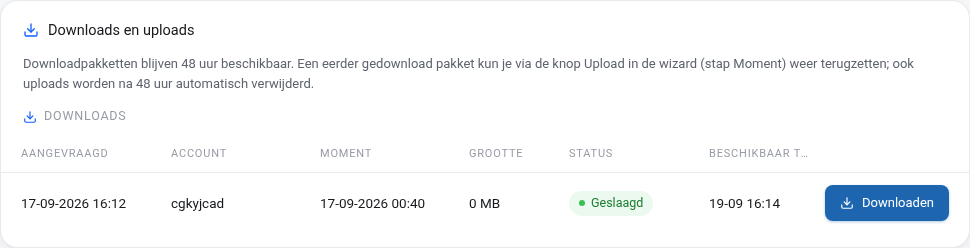
Below the wizard is the overview Downloads and uploads. A download package remains available for 48 hours, and the download link only works if you are logged in. A previously downloaded package can be restored again later: in the Moment step, choose Upload, select the file, and go through the remaining steps. Uploads are also automatically deleted after 48 hours.
A download package is retrieved in one go, no matter how large it is, even a complete account of many gigabytes. If your connection drops halfway through, you can resume the download in your browser. If that doesn't work, click Download again. Got the package safely, or no longer need it? Use the trash icon next to the package to delete it from the storage server immediately. Otherwise it will disappear automatically after 48 hours.
Previous restores
Every restore appears in the Previous restores list with the date, an eight-character restore code, the account, the moment, the method, the components and the status. With Result, you open the report, which shows for example how many files were restored and in which folder. If a restore is still running, it shows Follow live. Mention the restore code if you have a question for us about a restore.

Frequently asked questions
How long are backups kept?
There's a backup from every night of the past 30 days.
Can I delete a backup?
An extra backup you've made yourself with Create new backup now can: select it in the Moment step and click Delete this backup. The nightly backups can't be deleted. They also don't count towards the storage space of your package, so deleting them won't free up any space. You delete a download package using the trash can in Downloads and uploads.
Will I lose what changed after the backup?
With a full restore, yes. Not sure? Then choose Only restore what's missing or changed or a copy. With a full restore, leave the safety backup turned on, so we can always retrieve the state from just before the restore.
How long does a restore take?
That depends on the amount of files and mail. A single folder or database is usually restored within a minute, a complete account with a lot of mail can take longer. You don't have to wait: you'll get an email as soon as it's done.
My restore failed. What now?
You'll get an email and the restore will show with the status failed in Previous restores. Open the report with Result: it shows what went wrong. Try again with Try again. If the safety backup beforehand fails, nothing has been restored and nothing has been deleted. If it still doesn't work after that, create a ticket and mention the eight character restore code. Then we can look it up right away.
I can't start a new restore.
As long as a restore is running for that account, you can't start a new one. Wait until it's done, or stop it with Stop.
The hosting account no longer exists on the server.
If you've had the account (or the package) deleted, you can't restore it yourself. Create a ticket or call us, and we'll restore the account with the backup.
I don't see WebOké Backups in my menu.
WebOké Backups is enabled for every hosting package and mail package. If you don't see the item, your account doesn't have an active package, or you're logged in as a subuser without access to products. Log in as the main account or create a ticket.
Still stuck?
Create a ticket through the Support Center, and we'll help you further.
See also in the DirectAdmin manual: Which backups are available with WebOké.
Detailed explanation with screenshots: Can this also be done in My WebOké? WebOké Backups in the DirectAdmin manual.